

You worked eight and a half hours, so you write "8.30" on the time card. Seems right. It isn't. To payroll, 8.30 means eight hours and eighteen minutes, and those missing twelve minutes come out of your pocket every single shift. Here's how decimal hours actually work, with a chart you can bookmark and never think about again.
- Divide the minutes by 60: 45 minutes ÷ 60 = 0.75.
- 7 h 45 m = 7.75 hours. 8 h 20 m = 8.33. 38 h 30 m = 38.5.
- Going back: multiply the decimal part by 60. 0.4 h × 60 = 24 minutes.
- 8.30 is not 8 hours 30 minutes. It's 8 hours 18 minutes.
- Converting a lot? Use the free decimal hours converter.
Disclosure: Timelog is our app. The formula, chart and rounding rules here work with any time card, spreadsheet or app.
How do you convert minutes to decimal hours?
Divide the minutes by 60, then add the result to the whole hours.
Payroll loves decimals for one reason: you can multiply them by a rate. "7:45 × $18" means nothing to a calculator. "7.75 × $18" is $139.50.
Good news: you only really need to memorise three numbers.
To go the other way, keep the whole hours and multiply the decimal part by 60. 6.4 hours is 6 hours plus 0.4 × 60 = 24 minutes.
What does a real shift look like in decimal?
Work out hours and minutes first, divide the leftover minutes by 60, then multiply by your rate.

The Saturday baristaSay you're a barista and Saturday came to 7 hours 45 minutes after your break. 45 ÷ 60 = 0.75, so that's 7.75 hours. At $18 an hour: 7.75 × $18 = $139.50.

The electrician's weekFive shifts add up to 38 hours 30 minutes. 30 ÷ 60 = 0.5, so the week is 38.5 hours. At $32 an hour: 38.5 × $32 = $1,232.00.
Not sure how to get the hours and minutes in the first place? How to calculate hours worked covers lunch breaks and shifts past midnight.
Minutes to decimal chart (1–60)
Find your minutes, read the decimal, add it to your whole hours. Values are rounded to two places.
| Min | Decimal | Min | Decimal | Min | Decimal | Min | Decimal |
|---|---|---|---|---|---|---|---|
| 1 | 0.02 | 16 | 0.27 | 31 | 0.52 | 46 | 0.77 |
| 2 | 0.03 | 17 | 0.28 | 32 | 0.53 | 47 | 0.78 |
| 3 | 0.05 | 18 | 0.30 | 33 | 0.55 | 48 | 0.80 |
| 4 | 0.07 | 19 | 0.32 | 34 | 0.57 | 49 | 0.82 |
| 5 | 0.08 | 20 | 0.33 | 35 | 0.58 | 50 | 0.83 |
| 6 | 0.10 | 21 | 0.35 | 36 | 0.60 | 51 | 0.85 |
| 7 | 0.12 | 22 | 0.37 | 37 | 0.62 | 52 | 0.87 |
| 8 | 0.13 | 23 | 0.38 | 38 | 0.63 | 53 | 0.88 |
| 9 | 0.15 | 24 | 0.40 | 39 | 0.65 | 54 | 0.90 |
| 10 | 0.17 | 25 | 0.42 | 40 | 0.67 | 55 | 0.92 |
| 11 | 0.18 | 26 | 0.43 | 41 | 0.68 | 56 | 0.93 |
| 12 | 0.20 | 27 | 0.45 | 42 | 0.70 | 57 | 0.95 |
| 13 | 0.22 | 28 | 0.47 | 43 | 0.72 | 58 | 0.97 |
| 14 | 0.23 | 29 | 0.48 | 44 | 0.73 | 59 | 0.98 |
| 15 | 0.25 | 30 | 0.50 | 45 | 0.75 | 60 | 1.00 |
Thirds like 20 minutes (0.333…) get rounded. For pay that's exact to the cent, multiply minutes by your rate ÷ 60 instead: 20 minutes at $18 an hour is 20 × $0.30 = $6.00.
Why is 8.30 hours not 8 hours 30 minutes?
Because decimal hours count hundredths of an hour, not minutes: 8 hours 30 minutes is 8.5 hours, while 8.30 is only 8 hours 18 minutes.
This is the most common time card mistake, and it never goes in your favour. Clock-style times dropped into a decimal column lose time on every shift that isn't a round hour:
| You worked | Written as | Should be | Time lost |
|---|---|---|---|
| 8 h 30 m | 8.30 | 8.50 | 12 minutes |
| 7 h 45 m | 7.45 | 7.75 | 18 minutes |
| 6 h 50 m | 6.50 | 6.83 | 20 minutes |
Now put a price on it. Our barista works five 7 h 45 m shifts a week at $18 and writes "7.45" every time. That's $5.40 lost per shift, $27 a week, and about $1,350 over a 50-week year. All from a dot.
Quick check: a colon (8:30) means hours and minutes. A decimal point (8.50) means decimal hours. Ask which one your employer wants.
How does time clock rounding work?
Many employers round punches to the nearest quarter hour, tenth of an hour or 5 minutes, which federal FLSA guidance allows only if it evens out over time.
Quarter hours and the 7-minute rule
Punches round to the nearest :00, :15, :30 or :45. 1 to 7 minutes past rounds down; 8 to 14 rounds up. Clock in at 8:07 and it counts as 8:00. Clock in at 8:08 and it counts as 8:15.
Tenths of an hour
Some payroll systems count in 6-minute blocks, each worth 0.1 hours, usually rounded to the nearest tenth (3 minutes or less rounds down).
How do you do it in Excel or Google Sheets?
Multiply the time by 24: if A2 holds 7:45, =A2*24 returns 7.75.
=A2*24works because spreadsheets store time as a fraction of a day. Format the result as a number, not a time.=HOUR(A2)+MINUTE(A2)/60reads more clearly but ignores anything over 24 hours.- Start in B2, end in C2:
=(C2-B2)*24. Past midnight:=MOD(C2-B2,1)*24. - Back to clock time:
=A2/24, formatted as[h]:mm.
Can you skip the conversion entirely?
Yes. An app or calculator that tracks in minutes does the conversion and the pay math for you.
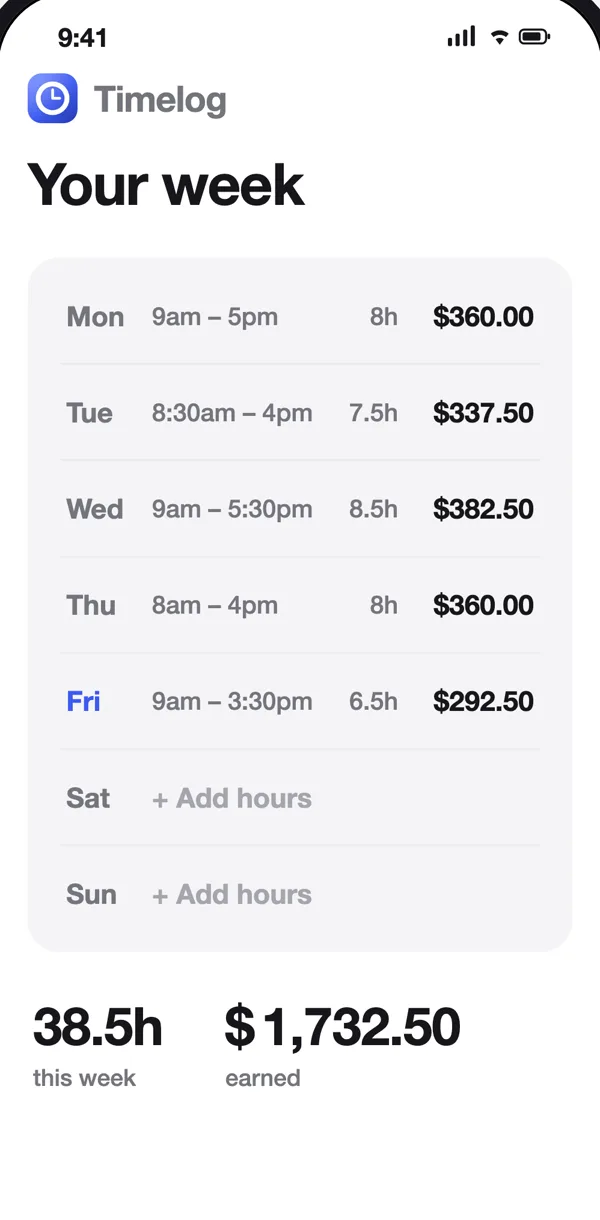
Timelog stores every shift in minutes and shows it as hours and minutes (7h 45m) next to what you earned, so there's nothing to divide or round by hand. Exported timesheets come already totalled for the week or month.
On a computer right now? The free time card calculator takes start, end and break times for each day and shows the week in both formats, plus overtime and gross pay. For overtime itself, see how to calculate overtime pay.
Frequently asked questions
What is 7 hours 45 minutes in decimal?
7 hours 45 minutes is 7.75 hours. Divide 45 minutes by 60 to get 0.75, then add it to the 7 hours.
How do I convert minutes to decimal hours?
Divide the minutes by 60. For example, 20 minutes ÷ 60 = 0.33 hours, so 8 hours 20 minutes is 8.33 hours. Add the result to the whole hours.
How do I convert decimal hours back to hours and minutes?
Keep the whole number as hours and multiply the decimal part by 60 to get minutes. For example, 6.4 hours is 6 hours plus 0.4 × 60 = 24 minutes, so 6 hours 24 minutes.
Is 8.30 hours the same as 8 hours 30 minutes?
No. 8 hours 30 minutes is 8.5 hours in decimal. 8.30 decimal hours is only 8 hours 18 minutes, so writing 8.30 on a decimal time card underpays you by 12 minutes.
Can my employer round my time clock punches?
Under federal FLSA rules, an employer may round punches to the nearest 5 minutes, tenth of an hour or quarter hour, as long as the rounding is neutral over time and does not consistently cut paid time. With quarter-hour rounding, 1 to 7 minutes round down and 8 to 14 minutes round up. Some states, such as California, apply stricter rules.