

You open your pay stub, do the math twice, and it's still short. You mention it to your manager, who shrugs and says the four words every hourly worker dreads: "The system says…" Here's the good news. The system isn't the last word, and you don't need a lawyer to start fixing it. You need a clear record, a calm message, and to know where to go next.
- Keeping accurate time records is your employer's legal duty, not yours. If their records are wrong or missing, your own reasonable records can be used instead.
- The best proof is a log you made at the time, backed up by texts, schedules and pay stubs.
- Raise it in writing first. If that fails, the US Department of Labor takes wage complaints for free: 1-866-487-9243.
- Federal deadline: generally 2 years, or 3 if the violation was willful.
Can an employer refuse to pay for hours you worked?
No. If you are a non-exempt (usually hourly) employee in the US, your employer must pay you for every hour you worked, including overtime, whether or not their timekeeping caught it.
The FLSA makes employers keep accurate records of hours worked and wages paid for every non-exempt worker. That duty is theirs. They can't hand it to you, and "it isn't in the system" doesn't make the time you worked disappear.
Missing pay usually hides in the same few places:
- Shifts that ran late but were paid at the scheduled end time
- "Automatic" meal breaks deducted on days you never sat down
- Opening up before clock-in, or closing and cleaning after clock-out
- Time cards edited down, or overtime quietly "moved" into next week
- Hours over 40 paid at straight time instead of time and a half (see how to calculate overtime pay)

Say you're a server on a double.The POS auto-deducts a 30 minute lunch every shift, but on Saturdays you never get one. Over a month that's 2 hours you worked and weren't paid for. It's small enough to miss, and big enough to matter.
Most short paychecks are honest mistakes that get fixed the moment someone shows the dates. Either way, the fix starts in the same place: a clear record of what you worked.
What counts as proof of hours worked?
Almost anything that shows when you were working can count, but a log written at the time, with dates and times, is the strongest single piece of evidence you can bring.
When an employer's records are inaccurate or missing, the Supreme Court's decision in Anderson v. Mt. Clemens Pottery Co. (1946) lets employees prove their hours with their own reasonable records and estimates. The employer then has to show the precise hours or prove your estimate is unreasonable. So your evidence doesn't have to be perfect. It has to be believable and consistent.
Here's how the usual evidence stacks up, from strongest to weakest:
| Evidence | Why it helps | How to keep it |
|---|---|---|
| A time log made at the time (notebook or app) | Same-day records beat a list rebuilt from memory months later | Log every shift the day you work it; export copies |
| Badge, door, POS or login records | Objective timestamps that are hard to argue with | Usually held by the employer; note they exist so they can be requested |
| Texts and emails with your manager | "Can you stay till close?" pins down a specific late night | Screenshot important threads to your own phone |
| Schedules and rota screenshots | Show the shifts you were expected to work | Screenshot each new schedule with the date visible |
| Pay stubs | Show what you were actually paid for, to compare against your log | Save every one, including from the payroll app |
| Coworker statements | Back you up, for example that everyone stayed to close | Note who was on shift with you |
| Bank deposits | Show what landed and when | Download statements for each pay period |
A personal log is evidence, not automatic proof. It carries the most weight when it's consistent (every shift, not just the disputed ones), specific (times, not "worked late") and made at the time. If you correct an entry later, say so and why. Unexplained edits are what make a record look shaky.
What should you do if you were not paid for all your hours?
Compare your pay stub against your own record, write down the exact difference by date, and raise it calmly in writing before going to an outside agency.
Line up stub and log
For each pay period, list the dates, the hours you worked and the hours you were paid. Work out the gap in hours and dollars. Our guide to calculating hours worked covers breaks and decimal hours.
Rule out the boring explanation
A shift may have landed in the next pay period, or a break may have been auto-deducted. Better to know before you raise it.
Ask in writing
Email or message your manager or HR with the dates and amounts (template below). Writing creates a dated record that you raised it.
Ask for your time records
Many states give employees the right to see or get copies of their payroll and time records.
Keep copies somewhere you control
Not a work phone, work email or the employer's app, which you can lose access to overnight. Forward or export to your personal email.
Escalate if it isn't fixed
File a wage complaint (below) or talk to an employment lawyer.
What should you say to your manager?
Keep it short, factual and specific: the pay period, the dates, the hours you worked versus the hours paid, and a request to correct it by the next paycheck.
Subject: Missing hours on my [date] paycheck
Hi [name],
I think my paycheck for [pay period] is missing some hours. My records show:
- [Tue, Sep 9]: worked 8:00 AM to 7:00 PM, 1 hour break = 10 hours; paid for 8
- [Sat, Sep 13]: worked 4:00 PM to 11:30 PM, 30 min break = 7 hours; not paid
That's 9 hours in total, 2 of them overtime. Could you check this and add it to the next paycheck? I've attached my timesheet for the period.
Thanks, [your name]
Stay neutral. No accusations, no mention of lawyers in a first message. Most payroll mistakes get fixed right here, and a calm, specific note is much easier to say yes to than an angry one.

Say you're in retail and always kept after close.You clock out at 9:00, then count the till and lock up until 9:20, five nights a week. That's 100 minutes a week off the clock. Write it down every night for two weeks, then send the message above with the dates. Specific beats frustrated.
How do you file a wage complaint?
You can file a free, confidential complaint with the US Department of Labor's Wage and Hour Division by calling 1-866-487-9243 or online, or with your state's labor department.
- US Department of Labor, Wage and Hour Division (WHD). Free, confidential, and available regardless of immigration status. Have ready: your employer's name and address, your job, how and when you were paid, and your record of hours.
- Your state labor department. Often the better first stop, because state laws can cover more workers, set a higher minimum wage, add daily overtime or allow longer deadlines.
- Small claims court. For smaller amounts you can sue without a lawyer in many states. Your log, stubs and messages are your evidence.
- An employment lawyer. Many take wage cases on contingency, meaning they're paid from what they recover. The FLSA can also require employers to pay your attorney's fees when you win.
Deadlines are the part people miss. Each short paycheck usually starts its own clock, so waiting can mean losing the oldest weeks. And retaliation is illegal: under the FLSA your employer can't fire you, demote you or cut your hours for complaining about pay. Keep copies of everything you send.
How do you start keeping a record today?
Write down every shift on the day you work it: the date, start and end time, breaks, which job, and a short note about anything unusual.
A good record has six things: the date, your start time (including anything before clock-in), your end time (including closing after clock-out), the breaks you actually took, the job or location, and notes such as who asked you to stay. Do it every shift, not only when something feels off, and once a week save a copy outside the app or notebook.
Screenshot the schedule the day it's posted. Schedules change, and the old version is often the one that proves you were asked to come in. Two seconds now saves an argument later.
A paper notebook works. So does a notes app. A time tracking app is faster: you tap to clock in and out, the times are stamped for you, and hours and pay add up on their own.
Disclosure: Timelog is our app. It's one way to do this, not the only one.
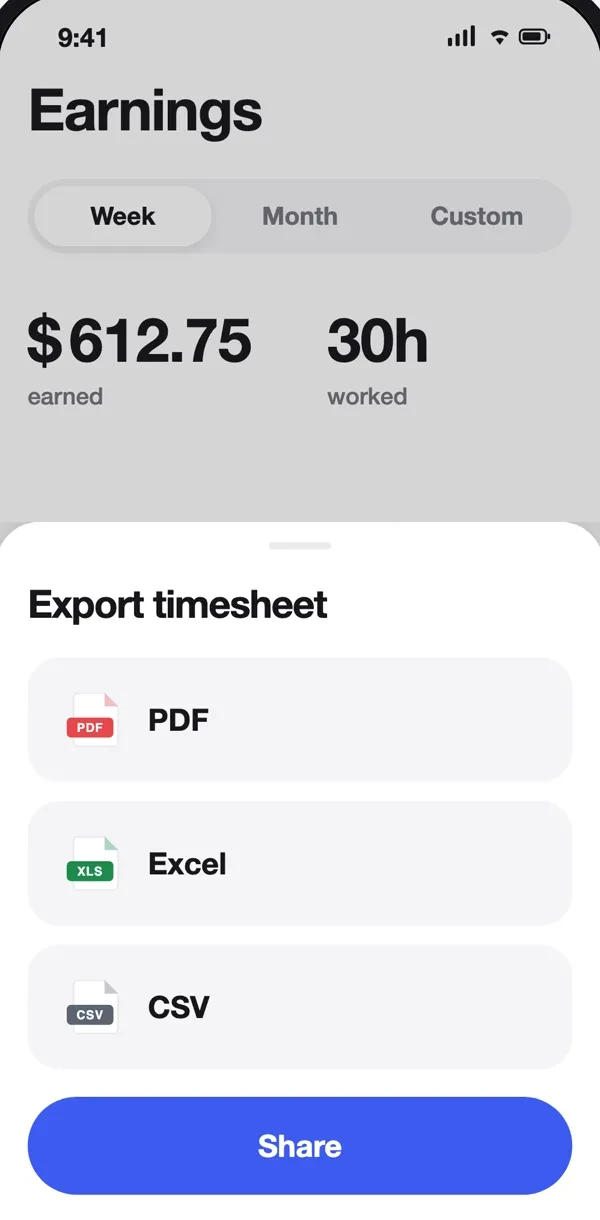
In Timelog you clock in and out with one tap or add a shift afterwards, record breaks, and add a note to any shift. Entries live on your iPhone, not on your employer's system, so they come with you if you change jobs. With Premium you can export any week or month as a PDF, Excel or CSV timesheet to email to yourself or attach to that message.
One honest caveat: Timelog lets you edit entries, because everyone forgets to clock out sometimes. If you change a shift after the fact, add a line in its notes saying what and why ("forgot to clock out, left 7:10 PM per text to manager"). That keeps your record credible.
If you're owed money right now, start with what you have: schedule screenshots, messages and pay stubs. Then log every shift from today, so if it happens again, you're the one with the clearest record in the room.
Frequently asked questions
Can an employer not pay you for hours worked?
No. Under the federal Fair Labor Standards Act, non-exempt employees must be paid for all hours worked, at least the minimum wage, and overtime at 1.5 times the regular rate for hours over 40 in a workweek. Many states add stricter rules. An employer that skips hours, edits time records down or asks you to work off the clock is generally breaking the law.
Is it legal for an employer to withhold pay?
Generally no. An employer cannot hold back wages you have already earned, for example to punish you, cover a till shortage or because you quit. Some deductions are allowed, such as taxes or ones you agreed to in writing, but state laws limit them. If pay is being withheld, ask for an explanation in writing and contact your state labor department.
Is my own record of hours enough to prove I worked them?
It can be. When an employer's records are missing or inaccurate, courts let employees prove hours with their own reasonable records and estimates; the Supreme Court set this out in Anderson v. Mt. Clemens Pottery Co. (1946). A personal log is strongest when it was written at the time, is consistent and is backed up by other evidence such as texts, schedules or pay stubs.
How long do I have to claim unpaid wages?
Under federal law you generally have 2 years from the missed paycheck to recover unpaid wages, or 3 years if the violation was willful. Many states allow longer. Each short paycheck usually starts its own clock, so acting sooner protects more of the money.
Can I be fired for complaining about unpaid wages?
Retaliating against an employee for complaining about wages or filing a wage complaint is illegal under the FLSA, and most states have similar protections. Keep your complaint in writing and save copies, so there is a record of when you raised it.