

It's Friday. Your paycheck says 36.5 hours. You swear it was more: there was that close on Tuesday, the extra half hour Thursday, the shift you covered for someone. But you can't prove it, because you never actually added it up. Here's how to do it properly, in about two minutes a day.
- Hours worked = end time − start time − unpaid breaks.
- Turn minutes into decimals by dividing by 60 (45 minutes = 0.75).
- Pay = decimal hours × hourly rate. Keep each workweek separate for overtime.
- Hate math? Use the free time card calculator for a week, or the work hours calculator for a single shift.
What is the formula for hours worked?
To calculate hours worked, subtract your start time from your end time, then subtract any unpaid breaks.
That's it. Everything else in this guide is just the awkward cases: shifts that cross midnight, days split in two, and minutes that refuse to behave like normal numbers.
How do you calculate hours worked, step by step?
Convert both times to a 24-hour clock, subtract hours and minutes, take out unpaid breaks, then convert minutes to a decimal if you need pay.
Write down start and end
Use the actual times you clocked in and out, not your scheduled ones. Example: 8:30 AM to 5:15 PM.
Switch to a 24-hour clock
Add 12 to any PM hour (except 12 PM). 5:15 PM becomes 17:15. Now there's no AM/PM confusion.
Subtract, borrowing if you need to
17:15 − 08:30. Fifteen minus thirty doesn't work, so borrow an hour: 16:75 − 08:30 = 8 hours 45 minutes.
Take out unpaid breaks
With a 45-minute unpaid lunch: 8:45 − 0:45 = 8 hours. Paid breaks stay in.
Convert to decimal and multiply
Divide leftover minutes by 60, then multiply by your rate. 8.00 hours × $18.50 = $148.00.
Write it down the same day. The math is easy. Remembering on Friday that you clocked out at 5:40 on Tuesday is not. Most lost hours aren't math errors, they're memory errors.
What about split shifts, night shifts and lunch?
Calculate each block of work on its own and add them together; for a shift past midnight, add the hours before midnight to the hours after it.

Say you're a line cook on a split shiftYou work lunch from 11:00 AM to 2:30 PM, go home, and come back for dinner from 5:00 PM to 9:15 PM. That's 3h 30m plus 4h 15m = 7 hours 45 minutes (7.75). The three hours at home don't count.

Say you're a nurse on nightsYou start at 10:00 PM and finish at 6:30 AM with a 30-minute unpaid break. Before midnight: 2 hours. After: 6h 30m. Total on the clock 8h 30m, minus the break = 8 hours. Shortcut: if the end is earlier than the start, add 24 hours to the end (30:30 − 22:00 = 8:30).

Say you're a barista working 9 to 5That's 8 hours on the clock. With a 30-minute unpaid lunch you worked 7.5 hours; with a full hour, 7. If your lunch is paid, it's the full 8.

How do you add up hours for a week?
Calculate each day, add the hours and the minutes separately, then turn every 60 minutes into an hour.
| Day | Start | End | Unpaid break | Hours | Decimal |
|---|---|---|---|---|---|
| Mon | 9:00 AM | 5:30 PM | 30 min | 8:00 | 8.00 |
| Tue | 8:45 AM | 5:00 PM | 30 min | 7:45 | 7.75 |
| Wed | 9:00 AM | 6:15 PM | 45 min | 8:30 | 8.50 |
| Thu | 9:15 AM | 5:30 PM | 30 min | 7:45 | 7.75 |
| Fri | 9:00 AM | 4:20 PM | 30 min | 6:50 | 6.83 |
| Total | 38:50 | 38.83 |
Hours: 8 + 7 + 8 + 7 + 6 = 36. Minutes: 0 + 45 + 30 + 45 + 50 = 170, which is 2 hours 50 minutes. Total: 38 hours 50 minutes.
At $18.50 an hour, use the exact fraction: 38 + 50/60 = 38.8333…, × $18.50 = $718.42. Round to 38.83 first and you get $718.36. Six cents isn't much, but round once, at the end. And whatever you do, don't write 38:50 as "38.50". That's 20 minutes you just gave away. (The minutes to decimal chart has every value.)
What is the Excel formula for hours worked?
In Excel or Google Sheets, subtract the start cell from the end cell, subtract the break, and format the result as [h]:mm.
Put the start time in B2, end time in C2 and the unpaid break in D2 as a duration (0:30). Then:
- Hours with a lunch break:
=(C2-B2)-D2, formatted as[h]:mm. - Overnight shifts:
=MOD(C2-B2,1)-D2. MOD wraps past midnight, and works for day shifts too, so just use it everywhere. - Decimal hours:
=E2*24. Excel stores time as a fraction of a day, so ×24 turns 8:00 into 8. - Pay:
=E2*24*F2, with your hourly rate in F2. - Break in minutes instead:
=MOD(C2-B2,1)*24-D2/60if D2 holds 30 rather than 0:30. - Weekly total:
=SUM(E2:E8)as[h]:mm. The square brackets matter: plainh:mmresets at 24 and shows 38:50 as 14:50, which is a fun way to lose a day.
Spreadsheets work, as long as you fill them in. That's the hard part.
How do you calculate biweekly, monthly and yearly hours?
Add up each week's hours, then add two weeks for biweekly, multiply by 52 for a year, and divide the year by 12 for an average month.
- Biweekly: a 38:50 week plus a 41:15 week is 80 hours 5 minutes for the pay period.
- Full-time year: 40 × 52 = 2,080 hours; that's 173.33 a month on average.
- Part time: 25 hours a week × 52 = 1,300 hours a year, about 108.33 a month.
One trap: don't treat a biweekly period as one block for overtime. US federal overtime counts per workweek, so 44 hours then 36 hours is 80 total, but you're still owed 4 hours of overtime for week one. More in our overtime pay guide.
Are breaks counted as hours worked?
Under US federal rules, short breaks of about 5 to 20 minutes are generally paid time, while meal breaks of 30 minutes or more where you are fully off duty are generally unpaid.
So the 15-minute coffee break stays in your hours; the 30-minute lunch where you actually leave usually comes out. If you're eating at the till or answering phones, that's generally still work. States add their own rules (California requires meal and rest breaks, with penalties when they're missed), so check your state labor department. General information, not legal advice.
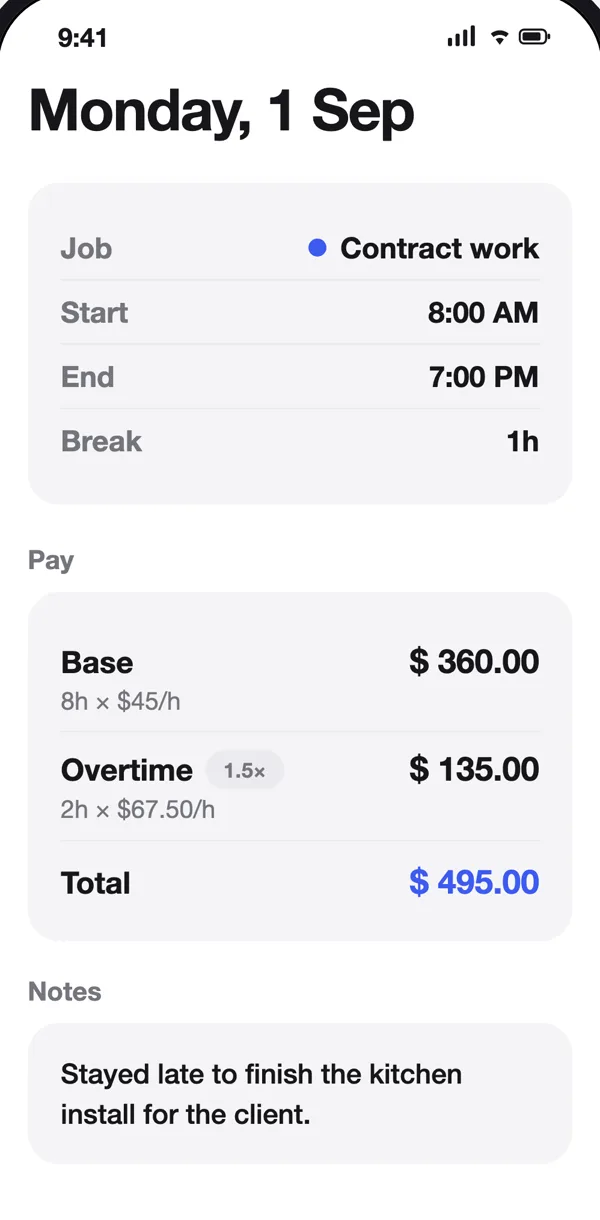
In Timelog you set a default break per job, it's deducted automatically when you clock out, and you can tweak it on any shift. Split shifts are just two entries on the same day, and a shift ending the next morning counts as one.
Timelog is our app. Every formula here works just as well with a pen or a spreadsheet.
Frequently asked questions
How do I calculate hours worked with a lunch break?
Subtract the start time from the end time, then subtract the unpaid lunch break. For example, 8:30 AM to 5:15 PM is 8 hours 45 minutes; minus a 45-minute lunch, that is 8 hours worked.
How do I calculate hours worked in decimal?
Divide the minutes by 60 and add them to the whole hours. 7 hours 45 minutes is 7 + 45 ÷ 60 = 7.75 hours. See the minutes to decimal hours chart for every minute value.
What is the Excel formula for hours worked with start and end times?
With the start time in B2, the end time in C2 and the unpaid break in D2 (entered as a time like 0:30), use =MOD(C2-B2,1)-D2 and format the cell as [h]:mm. Multiply by 24 to get decimal hours, and multiply that by your hourly rate to get pay.
How many hours is 9 to 5 with a lunch break?
9 AM to 5 PM is 8 hours on the clock. With a 30-minute unpaid lunch you work 7.5 hours; with a 1-hour unpaid lunch you work 7 hours. If the lunch is paid, you work the full 8 hours.
How do I calculate hours worked over two weeks?
Total each week separately, then add the two weeks together for the pay period. Keep the weeks separate because US federal overtime is based on hours over 40 in a single workweek, not over 80 in a two-week period.