Timesheet
Week of
| Day | In | Out | Break | Hours | Decimal |
|---|---|---|---|---|---|
| Regular hours | 0:00 | 0.00 | |||
| Overtime hours | 0:00 | 0.00 | |||
| Total hours | 0:00 | 0.00 | |||
Made with the free Timelog time card calculator
- Hours each day = end time − start time − unpaid break.
- Decimal hours = hours + minutes ÷ 60 (for example 8h 15m = 8.25).
- Gross pay = regular hours × rate + overtime hours × rate × overtime multiplier.
How do you calculate a time card by hand?
For each day, subtract the start time from the end time, subtract unpaid breaks, then add up the days and convert minutes to a decimal before multiplying by your hourly rate.
Here is a week worked at $22.50 an hour with a 30 minute unpaid lunch each day:
| Day | Start | End | Break | Hours | Decimal |
|---|---|---|---|---|---|
| Mon | 8:00 AM | 4:30 PM | 30 min | 8:00 | 8.00 |
| Tue | 8:00 AM | 5:15 PM | 30 min | 8:45 | 8.75 |
| Wed | 7:45 AM | 4:30 PM | 30 min | 8:15 | 8.25 |
| Thu | 8:00 AM | 5:00 PM | 30 min | 8:30 | 8.50 |
| Fri | 8:00 AM | 4:30 PM | 30 min | 8:00 | 8.00 |
| Week | 41:30 | 41.50 | |||
With the weekly rule, 40 hours are regular and 1.5 are overtime: 40 × $22.50 = $900.00, plus 1.5 × $33.75 = $50.63, for $950.63 gross. Press "Fill example week" above to see the same numbers.
For more worked examples, including overnight and split shifts, read how to calculate hours worked.
Should lunch breaks be subtracted from hours worked?
Subtract a break only if it is unpaid; in the US, meal breaks of 30 minutes or more where you are fully relieved of duty are usually unpaid, while short rest breaks of 5 to 20 minutes are usually paid.
If you eat at your desk while answering the phone, that time generally counts as work. State laws add their own meal and rest break rules, so check your state labor department if you are unsure. Enter 0 in the break column for paid breaks.
How does this time card calculator work out overtime?
It applies the rule you pick: hours over 40 in the week, or hours over 8 in a day plus any remaining hours over 40 in the week, all paid at the multiplier you choose.
Federal law (the FLSA) requires time and a half after 40 hours in a workweek for non-exempt employees. A few states add daily overtime; California pays 1.5× after 8 hours in a day and 2× after 12. This calculator's daily mode covers the 8 hour rule but not double time, so for long California shifts follow the steps in our overtime pay guide.
How do I convert time card minutes to decimal?
Divide the minutes by 60 and add the result to the hours: 15 minutes is 0.25, 30 minutes is 0.5, and 45 minutes is 0.75.
| Minutes | Decimal | Minutes | Decimal | Minutes | Decimal |
|---|---|---|---|---|---|
| 5 | 0.08 | 25 | 0.42 | 45 | 0.75 |
| 10 | 0.17 | 30 | 0.50 | 50 | 0.83 |
| 15 | 0.25 | 35 | 0.58 | 55 | 0.92 |
| 20 | 0.33 | 40 | 0.67 | 60 | 1.00 |
The complete 1 to 60 minute table is in convert minutes to decimal hours.
Is there a time card calculator app for iPhone?
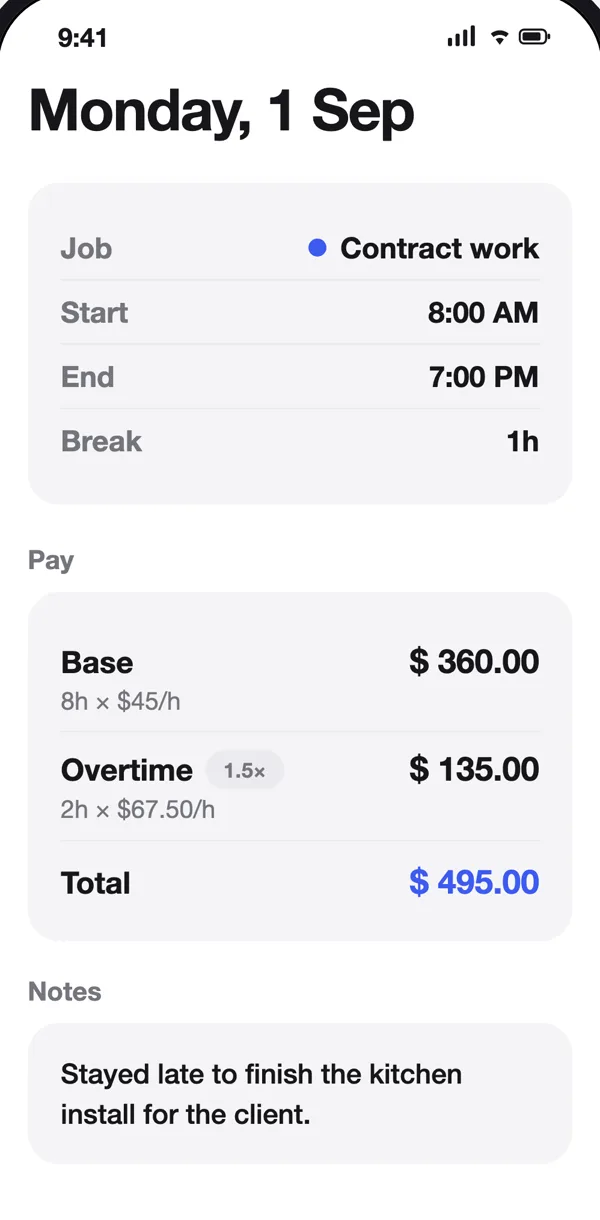
Yes. Timelog is a work hours tracker app for iPhone that does this calculation for every shift as you clock in and out, and keeps the record for you.
A calculator is good for checking one week. If you want the hours recorded as you work, with breaks deducted, overtime split out, and a timesheet you can export as PDF or Excel, Timelog saves you re-entering times every payday. Timelog is our app; it is free to download, and Premium adds overtime pay, multiple jobs, export and full history.
Frequently asked questions
How do I calculate hours worked with a lunch break?
Subtract the start time from the end time, then subtract the unpaid lunch break. For example, 8:30 AM to 5:00 PM is 8 hours 30 minutes; minus a 30 minute lunch is 8 hours, or 8.00 in decimal. The calculator does this for each day when you enter the break in minutes.
Does the calculator handle overnight shifts?
Yes. If the end time is earlier than the start time, the shift is treated as crossing midnight. 10:00 PM to 6:30 AM with a 30 minute break is 8 hours.
How is overtime calculated?
With the weekly rule, hours over 40 in the week are paid at your multiplier (1.5× by default). With the daily rule, hours over 8 in a day are overtime, and remaining regular hours over 40 in the week are also overtime, without counting any hour twice. The calculator does not apply California double time after 12 hours; see our overtime pay guide for that.
What does decimal hours mean on a time card?
Decimal hours write minutes as a fraction of an hour: 7 hours 45 minutes is 7.75 hours because 45 ÷ 60 = 0.75. Payroll multiplies decimal hours by your hourly rate. There is a full minutes to decimal chart in our guide.
Is the time card calculator free and private?
Yes. It runs entirely in your browser, nothing is uploaded, and the values you enter are only remembered on this device so the page keeps them if you reload.
Does this calculate my take-home pay?
No. The result is gross pay before tax, deductions and benefits. Your pay stub should show the same hours and gross amount if your employer used the same times and rules.