

The double ran past midnight. You closed the kitchen, mopped, walked to the car at 1 AM, and two weeks later the paycheck shows up looking like an ordinary Tuesday. Was that right? Overtime math is simple once you see it, and it's the line on a pay stub most worth checking. Here's how to do it in five minutes.
- Overtime rate = your hourly rate × 1.5. At $20/h that's $30/h.
- Federal overtime starts after 40 hours in a workweek.
- Paid biweekly? Each week counts on its own. Two weeks can't be averaged.
- California adds daily overtime: 1.5× after 8 hours, 2× after 12.
- "No tax on overtime" (2025–2028) covers only the extra "half", up to $12,500 ($25,000 joint).
- Want the math done for you? Try the free overtime calculator.
What is the formula for overtime pay?
Overtime pay is your overtime hours multiplied by 1.5 times your regular hourly rate, added to your regular pay for the first 40 hours of the workweek.
That rule comes from the federal Fair Labor Standards Act (FLSA), and it covers most hourly workers (the legal term is "non-exempt"). Three lines and you're done:
Overtime pay = overtime hours × (hourly rate × 1.5)
Total gross pay = regular pay + overtime pay

Say you're a line cook at $18 an hour who worked 52 hours this week. Regular: 40 × $18 = $720. Overtime rate: $18 × 1.5 = $27. Overtime: 12 × $27 = $324. Total: $1,044. Paid at straight time it would have been $936, so overtime is worth $108 that week.
Some payroll systems show it differently: every hour at straight time, plus a separate "OT premium" of half your rate on the overtime hours. At $20 an hour and 46 hours, that's 46 × $20 = $920 plus 6 × $10 = $60, the same $980 as 40 × $20 + 6 × $30. Same money, different labels.
One thing first: get your hours right. Take out unpaid breaks and convert minutes properly (7 hours 45 minutes is 7.75 hours, not 7.45). Our guide on how to calculate hours worked walks through it.
What's my overtime rate per hour?
For a straight hourly wage, your overtime rate is your hourly rate times 1.5; if you earn non-discretionary bonuses or shift differentials, they raise the "regular rate" that the 1.5 is applied to.
| Hourly rate | Time and a half (1.5×) | Double time (2×) |
|---|---|---|
| $15.00 | $22.50 | $30.00 |
| $18.00 | $27.00 | $36.00 |
| $20.00 | $30.00 | $40.00 |
| $22.50 | $33.75 | $45.00 |
| $25.00 | $37.50 | $50.00 |
| $30.00 | $45.00 | $60.00 |
| $45.00 | $67.50 | $90.00 |
The bonus part catches people out. Attendance bonuses, production bonuses and shift differentials generally have to be folded into the regular rate. Example: $18 an hour, 45 hours and a $90 production bonus. Straight pay plus bonus is $810 + $90 = $900, so the regular rate is $900 ÷ 45 = $20. The overtime premium is 0.5 × $20 × 5 = $50, for $950 total. Leave the bonus out of the rate and the premium drops to $45.
How is overtime calculated on a biweekly paycheck?
On a biweekly paycheck overtime is still calculated week by week: each workweek is checked against 40 hours separately, then the two results are added together.
This is the classic way overtime goes missing. Being paid every two weeks does not make the limit 80 hours. A workweek is a fixed 7-day period your employer sets, and the FLSA treats each one on its own.

Say you're a barista at $20 an hour covering for a sick coworker. You work 50 hours in week one and 30 in week two. That's 80 hours, which looks like two normal weeks. It isn't.
| $20/h, biweekly | Week 1 | Week 2 | Pay period |
|---|---|---|---|
| Hours worked | 50 | 30 | 80 |
| Regular hours | 40 | 30 | 70 |
| Overtime hours | 10 | 0 | 10 |
| Pay | $800 + $300 | $600 | $1,700 |
Paid as 80 × $20 = $1,600, you'd be $100 short: 10 overtime hours times the $10 premium. You only spot it if you keep your hours per week, not per paycheck.
Ask for your workweek. Payroll can tell you exactly when it starts (for example Sunday 12:00 AM). Use the same week boundaries in your own record and the comparison takes a minute.
How do you calculate overtime in California?
California pays 1.5× after 8 hours in a workday and after 40 in a workweek, 2× after 12 hours in a workday, and on the seventh consecutive workday 1.5× for the first 8 hours and 2× after that.
| Rule | Federal (FLSA) | California |
|---|---|---|
| Weekly overtime | 1.5× over 40 hours | 1.5× over 40 hours |
| Daily overtime | None | 1.5× over 8 hours in a workday |
| Daily double time | None | 2× over 12 hours in a workday |
| 7th consecutive day in a workweek | No special rule | 1.5× first 8 hours, 2× after 8 |
| Averaging weeks | Not allowed | Not allowed |

Say you're a nurse in California at $40 an hour working three 13-hour shifts. Each shift: 8 × $40 = $320, plus 4 × $60 = $240, plus 1 × $80 = $80, so $640 a shift and $1,920 for the week. That's only 39 hours, so federally there'd be no overtime at all: 39 × $40 = $1,560. California's daily rules are worth $360 here.

Two more to check your understanding. Four 10-hour days at $25: federally that's 40 hours and no overtime ($1,000). In California each day has 2 hours over 8, so 32 × $25 + 8 × $37.50 = $1,100. No hour is paid twice, and daily overtime hours aren't counted again toward the 40. A 10-hour seventh consecutive day at $25: 8 × $37.50 + 2 × $50 = $400.
A few other states, such as Alaska, Nevada and Colorado, also have daily rules with their own limits, and exemptions or alternative workweek schedules can change things. Your state labor department has the version that applies to you.
How does "no tax on overtime" work?
For tax years 2025 through 2028, you can deduct the premium portion of FLSA-required overtime from federal taxable income, up to $12,500 a year ($25,000 if married filing jointly); Social Security and Medicare still apply.
The headline makes it sound bigger than it is. What it actually covers, under the One Big Beautiful Bill Act (Internal Revenue Code §225):
- Only the "half". At $20 an hour with a $30 overtime rate, $10 of each overtime hour is deductible, not $30.
- Only federally required overtime. Overtime paid only because of a state daily rule or a union contract generally doesn't qualify.
- It phases out above $150,000 of modified AGI ($300,000 joint).
- You don't need to itemize. It lowers taxable income on top of the standard deduction.
- Records matter. For 2025, IRS Notice 2025-69 lets you use pay stubs or other records. From 2026, W-2s report qualified overtime separately.
Example: $20 an hour, 6 overtime hours a week, 50 weeks. That's $9,000 of overtime pay, but the deductible premium is 6 × $10 × 50 = $3,000.
How do I check overtime on my paycheck?
Compare the overtime hours and rate on your pay stub with your own record of each workweek, and ask payroll for the timecard they used if the numbers don't match.
Split the pay period into workweeks
Your stub covers the pay period; overtime is counted per week.
Total each week from your own record
Start to end, minus unpaid breaks, shift by shift.
Check the OT hours line
It should match weekly hours over 40, plus any daily overtime your state requires.
Check the OT rate
At least 1.5× your regular rate, more if a bonus or differential raised it that week.
Recalculate the total
A few cents is rounding. A whole overtime hour or more is worth raising, calmly and in writing.
If hours are missing, a dated record made at the time is the strongest thing you can bring. Our guide on how to prove hours worked covers what to keep and what to do next.
Can an app calculate overtime for you?
Yes, a work hours tracker app can calculate overtime as you log shifts, but check which rule it applies: daily, weekly, or both.
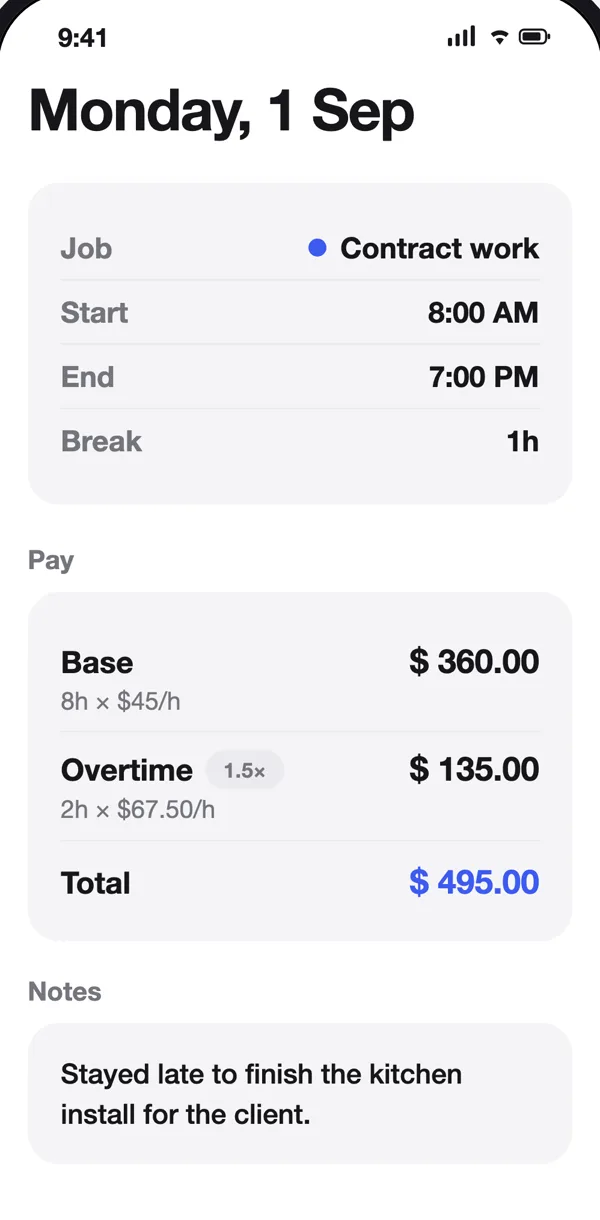
Disclosure: Timelog is our app. Here's exactly what it does with overtime, and what it doesn't.
- Daily overtime per shift. Set a threshold and multiplier per job, such as 1.5× after 8 hours a day (California-style). Each shift shows base and overtime as separate lines.
- Breaks come off first, then the shift is split at your threshold.
- The 40-hour weekly rule isn't applied automatically. Compare your weekly total on the Earnings screen with 40 using the formula above, or use the free time card calculator, which does apply it.
- Overtime pay is a Premium feature. The free version tracks hours, breaks and estimated earnings for one job.
- Not payroll. It estimates gross pay, not tax or the overtime deduction.
Weighing other options? Our roundup of the best apps to track work hours compares them.
Frequently asked questions
How do you calculate overtime pay?
Multiply your regular hourly rate by 1.5 to get the overtime rate, then multiply that by the overtime hours and add it to your pay for the first 40 hours. At $20 an hour and 46 hours: 40 × $20 + 6 × $30 = $980.
What is time and a half for $20 an hour?
Time and a half for $20 an hour is $30 an hour ($20 × 1.5). Double time would be $40 an hour.
Is overtime calculated per week or per pay period?
Under federal law overtime is calculated per workweek, a fixed 7-day period. You cannot average two weeks in a biweekly pay period: 50 hours one week and 30 the next still means 10 overtime hours, even though the total is 80.
How is overtime calculated in California?
California pays 1.5× for hours over 8 in a workday and over 40 in a workweek, 2× for hours over 12 in a workday, and on the seventh consecutive workday of a workweek 1.5× for the first 8 hours and 2× after that. An hour is only paid at one overtime rate, never counted twice.
Is overtime tax free in 2025?
Not fully. For tax years 2025 to 2028 you can deduct the premium portion of FLSA-required overtime (the extra half in time and a half) from federal taxable income, up to $12,500 a year or $25,000 for joint filers, phasing out above $150,000 of modified AGI ($300,000 joint). Social Security, Medicare and usually state income tax still apply.